
Buckingham Throttle: A Dual-System Game Changer?
Within the last few years in the Tree Care Industry, we have seen quite the advancement in tree climbing gear, tree work tips and tricks, and how easy we can access this information. With such a boom in the industry, does this mean we are at the plateau point? NOPE, as long as there are creative individuals who wish to keep the Tree Care Industry moving forward, there won’t (hopefully) be a plateau, whether it is a hit or a flop! Which brings us to the star of this blog, the Buckingham Throttle.

What is the Throttle?
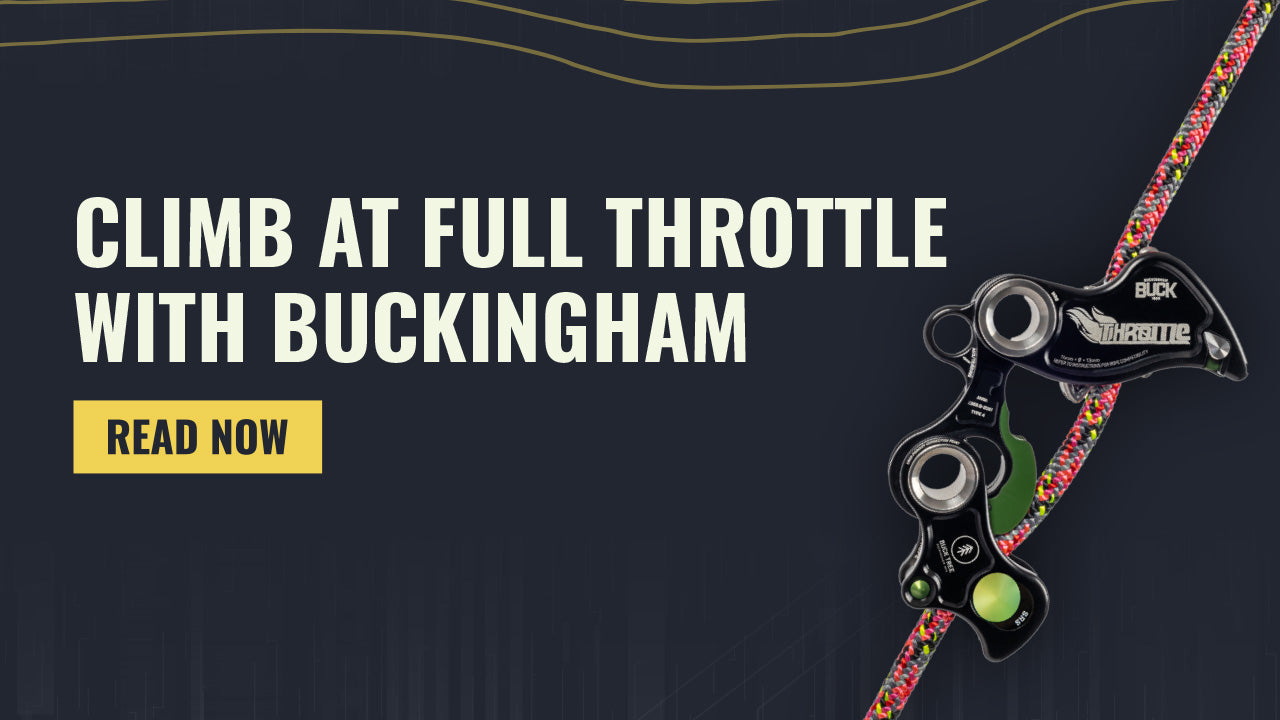
The Throttle is Buckingham’s newest mechanical ascender/descender designed for arborists. It is compatible with both moving rope and stationary rope systems without the need for additional tools. I’ve spoken with industry professionals, and the following phrase has been repeated on numerous occasions: “It’s an oversized Akimbo”. But after having climbed extensively with the Throttle, the shape is the only thing that this device and the Akimbo share; their functions, adjustability, and installation differ from each other!
Key Features of the Throttle
-
Dual upper cam technology. Located inside the upper lever arm, you will find TWO articulating inner cams. When loaded into the climbing device, the cams keep the rope in an optimal path to reduce unnecessary friction.
-
The dual cams also serve as an additional safety feature, which prevents the rope from exiting the upper cheek plate if it is not locked.
-
Locking mechanism. The upper lever’s locking mechanism requires 2 actions to unlock the cheek plate; pulling the inner lock away from the cheek plate and then rotating it slightly (clockwise) will unlock the upper cheek plate.
-
SRS/MRS toggle switch. Unlike the continuing trend of adjustable friction, the Buckingham Throttle only requires switching the toggle between MRS and SRS for the right climbing application.
-
Rated auxiliary/SRS tending connection. I placed this into the key feature because in the event someone inadvertently attaches themselves to this connection point, it will not fail. Certain mechanicals, when extremely loaded onto the SRS tending point, can cause the unit to fail. But that’s why we double-check our systems prior to ascending.
-
Also, it can be used in an M-Rig configuration.
-
MRS attachment point. This is the main selling point (in my mind) for those looking to expand their climbing experience.

Compatibility
As with any tool, there are compatibility concerns that are addressed in the user manual; remember, this is pretty much a contract between the user and the manufacturer.
Ropes. The accepted range of rope diameter will range from 11 mm to 13 mm ropes, ANSI Z133 compliant or EN 1891 Type A or B for our friends that must abide by European standards. Buckingham has released a recommended ropes list, not an approved rope list. So, if you don’t see a specific rope on that list, it doesn’t mean you can’t use it.
Carabiners. Oval carabiners are recommended for optimal device orientation. An oval carabiner can easily rotate inside the attachment point and will sit perfectly at the center of the carabiner. If a D-shaped or pear-shaped carabiner is placed in the attachment point(s), the carabiner will not rotate and can “awkwardly” become loaded inside the Throttle. Additionally, the user manual states “use only” shortly after stating “Buckingham recommends using only” – ANSI Z359.12 certified carabiners.
So, what is an ANSI Z359.12 carabiner, you might ask? Elementary, my dear Watson! Too cheesy?! ANSI Z359.12 is the American National Standard for connecting components for personal fall arrest systems to which carabiners must have an additional gate rating of 3,600 lb. (16kN) … along with passing additional tests per the standard.
My Experiences
Rope Install
If you haven’t already deciphered Buckingham’s code for installing the rope onto the upper arm, I highly recommend watching their video on how to do so, but even then, it can be a pain in the ass! As we all do, without reading/watching the how-to portion, I managed to squeeze my Kalimba rope through the dual cams of the Throttle and rode the struggle bus doing so. To reduce your headache, allow me to assist:
-
Begin by aligning the climbing rope with the cams and keeping the rope under tension
-
Place your thumb along the top of the rope with slight pressure
-
Slide the Throttle up the rope while pushing the rope downward, and it should “easily” seat into the cams
I found this method to still be somewhat difficult at times, so I have a slight modification that worked really well for me. Rather than applying downward pressure while sliding the device upward, I did the following:
-
Begin at the bottom of the cams and flare them outward
-
Align the rope at the bottom with the cams and apply slight pressure with your thumbs
-
Slide the Throttle upward and the rope upward
It doesn’t seem like that subtle change would make a difference, but let me tell you, it one hundred percent did! The bottom lever arm is simple; depress the button, open the cheek plate, set the toggle switch to the correct function, install the rope, close it, and done. Detaching the upper arm of the Throttle requires tilting the device away from you until it is at a 90-degree angle, pulling on the fall towards you while pulling the device away.
Ascent/Descent/Movement
During my ascent, I experienced some drag, which is whatever; this is a work device and not a competition tool. The descent technique - that’s right, descent technique – requires the user to rotate out and down to collapse for descent and not a straight down pull. I like to climb on an 11.9mm Kalimba, and with that being said, the Throttle required quite the effort to collapse the unit for descent while in an SRS configuration. So much so, it felt like I was a bodybuilder holding a bicep pose for the judges! I did end up switching my rope to an 11mm rope that proved to be a bit smoother on the descent, but the collapse was still rough.

Movement for my climbing style did not feel fluid to me. As I attempted to swing out from a high position onto a limb that is further away, the descent on the device was inconsistent, either hitting the collapse too hard and missing the target or experiencing a choppy descent. But, if you don’t swing in the crown and focus on dropping into position and then slowly heading out to the work destination, the Throttle works well and responds as it should. But do keep in mind, as you generate enough heat, the Throttle will hit a small cruise control on descent.
Surprisingly enough, the Buckingham Throttle responded much better when it was set in a moving rope climbing system, almost as if it was designed for MRS. Where I struggled to collapse it for descent in SRS, I found it simpler to do so in MRS. Walking in from an awkward limb also proved simpler, which can probably just be attributed to the 2:1 mechanical advantage.
This climbing device prefers 11 mm to 11.7mm rope, so long as the rope is supple. Honestly, I did not try the device with a true half-inch rope; the thickest diameter I used with this device was a 12.2mm climbing rope, and well … yeah, as expected. I tried making this device work for me, but unfortunately, it didn't. However, if you are someone who likes to single up, double down; this device is for you. It is simple to switch modes and self-adjusts to the user’s position thanks to the hollow Dog Bone and lower lever construction. Share your thoughts with us.
Leave a comment