
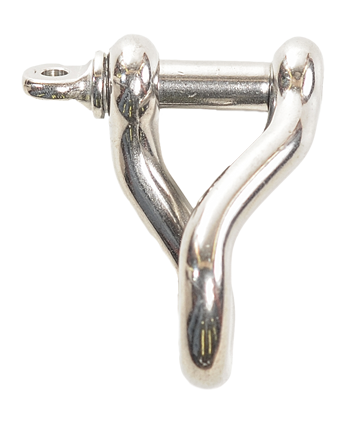
US Rigging Large Stainless Steel Twisted Clevis
The large version of our popular twisted clevis, built for climbers who need a heavier-duty connection on their positioning lanyard or rope grab. The 90-degree twist keeps your rope grab oriented correctly on the rope, reducing binding and improving function — whether you're hard-connecting to a hip D-ring or running it inline on a lanyard. Stainless steel construction handles outdoor exposure without corrosion, and the 3/8" pin provides a higher WLL than the small version for demanding applications. Lockable with pliers for a secure, rattle-free connection.
Key Features
- 90-degree twist helps rope grabs orient correctly on the rope
- Stainless steel construction for corrosion resistance and durability
- 3/8" pin diameter — heavier duty than the small clevis
- Lockable with pliers — secure when closed, removable when needed
- Ideal for positioning lanyards and hip D-ring rope grab connections
- WLL: 2,000 lbs (9kN)
Specifications
| Spec | Value |
|---|---|
| Material | Stainless Steel |
| Pin Diameter | 3/8" |
| Twist Angle | 90 degrees |
| WLL | 2,000 lbs (9kN) |
| Weight | 4.8 oz |
| Locking | Lockable with pliers |
| Vendor | US Rigging |
| Country of Origin | USA |
Frequently Asked Questions
What is the difference between the small and large twisted clevis?
The large twisted clevis uses a 3/8" pin (vs. 5/16" on the small) and has a higher WLL of 2,000 lbs (9kN) vs. 1,380 lbs (6kN). Choose the large version when you need a heavier-duty connection or when your hardware requires a 3/8" pin diameter.
What is a twisted clevis used for in arborist work?
A twisted clevis is primarily used on positioning lanyards to connect a rope grab to a climber's hip D-ring. The 90-degree twist allows the rope grab to sit at the correct angle on the rope, improving function and reducing wear on both the grab and the rope.
Why does the 90-degree twist matter?
Without the twist, a clevis connecting a rope grab to a hip D-ring forces the grab to sit at an awkward angle on the rope, potentially causing it to bind or function less efficiently. The twist corrects this geometry so the grab operates as designed.
What does WLL mean?
WLL stands for Working Load Limit — the maximum load the hardware is rated for in normal use. At 2,000 lbs (9kN), this large clevis provides a substantial safety margin for arborist positioning applications.
How is the clevis locked?
The clevis pin is lockable using pliers — no special tools required. This keeps the connection secure during use while still allowing removal when needed for system reconfiguration.